
Culture or Propaganda?
Haiti’s censored uniform and the opening-ceremony wars prove the Olympics are political by design—and “neutrality” is selective enforcement.

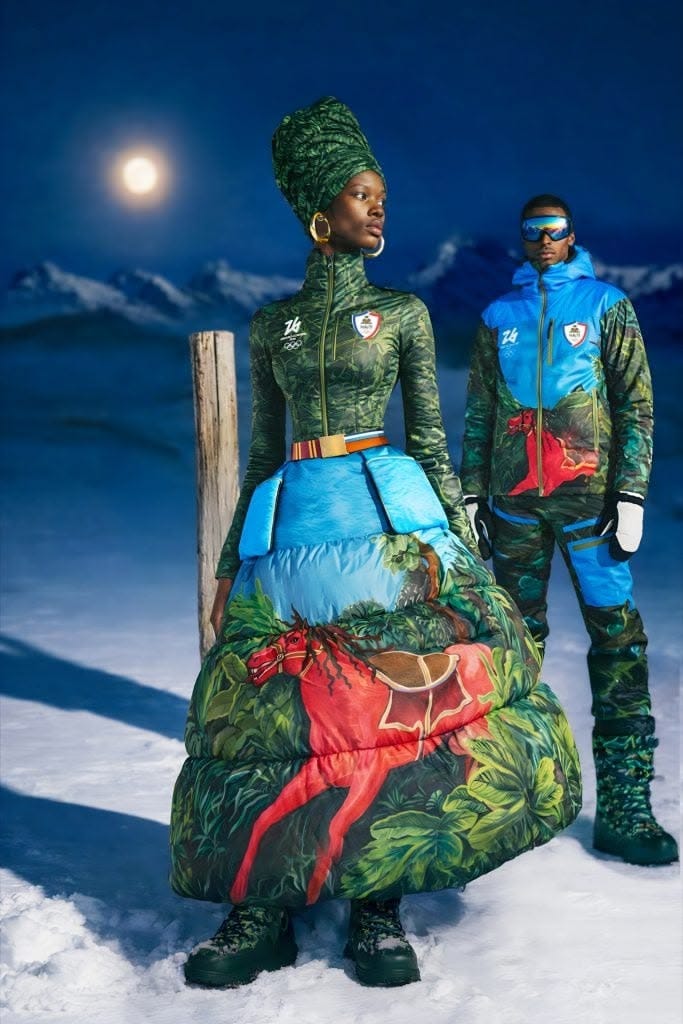
For the first time in the Winter Games’ century-long history, a team was forced to change its Olympic uniforms because the artwork on them was deemed “political.” Haiti’s design—Stella Jean’s translation of Edouard Duval-Carrié’s portrait of Toussaint Louverture—was not rejected for a slogan, but for a figure: an anti-colonial revolutionary rendered in paint and then erased under IOC rules on “political propaganda.”
The IOC’s January 4 decision gave Haiti’s two-person team very little time, forcing a last-minute redesign: artisans in Jean’s Rome studio repainted the uniforms by hand and delivered them to Milan two days before the opening ceremony. Jean insists the revision did not erase the message—“His absence speaks louder than his presence ever could,” she said—recasting censorship as composition and absence as a kind of resistant form.
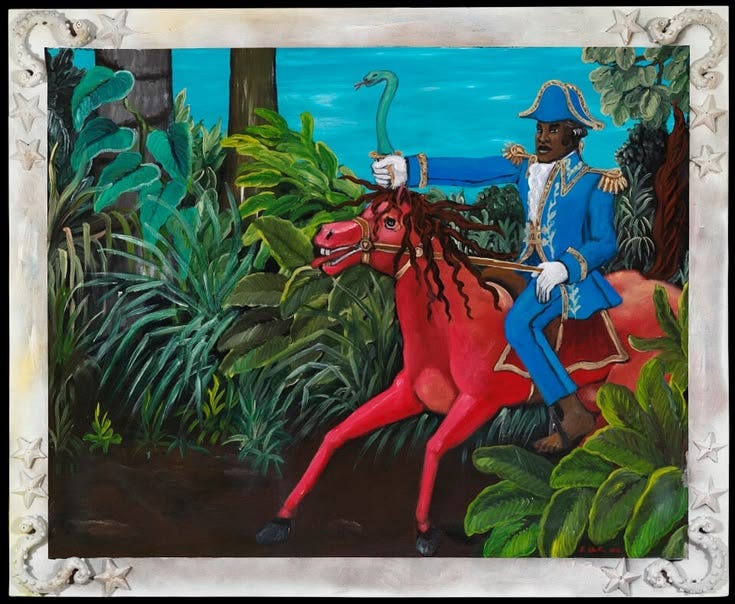
The original image wasn’t generic patriotism. Duval-Carrié’s Toussaint Louverture (2006) is revolutionary iconography: Louverture rides a red horse through a saturated green landscape, dressed in crisp blue yet barefoot, holding a snake where a sword would normally appear. Jean read the snake through Haiti’s Vodou tradition as Damballa—a symbol of wisdom, patience, and peace—folding spiritual lineage into political history. What Haiti attempted to wear was not propaganda in the partisan sense; it was a self-authored origin story: the formerly enslaved as agents of rupture, a Black republic born not from permission but from revolt.
That is what makes the IOC’s decision more than a dress-code dispute. Louverture is not simply a historical figure; he signifies reminder and refusal—anti-colonial insurgency, the dismantling of imperial claims, the audacity of Black sovereignty. To classify that image as impermissible “politics” is to reveal what the Olympics actually police: not politics versus no politics, but which histories are allowed to appear as culture and which must be edited into absence.
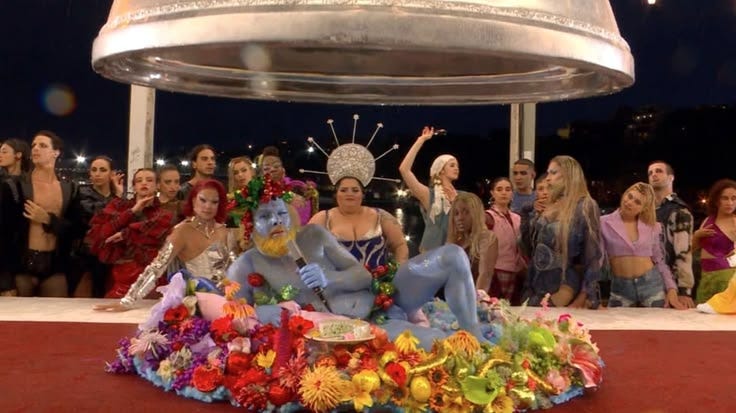
Paris 2024 offered the inverse lesson: even when nothing is formally censored, Olympic art is still received as ideology. Thomas Jolly’s opening ceremony staged a feast tableau featuring drag performers that many interpreted as a parody of Leonardo da Vinci’s The Last Supper, igniting outrage among religious groups and conservative politicians worldwide and prompting organizers to apologize to those offended while denying any intent to insult. Intent barely mattered. The image landed as politics because Olympic ceremony is designed to function as a collective mirror—and mirrors do not stay neutral for long.
Opening ceremonies are not decorative prelude; they are state-scale performances of national identity. As the Play the Game analysis argues, the host nation uses the ceremony to present “a very specific and staged image of the nation,” and for one-party states facing human-rights scrutiny, that staging becomes especially valuable. Jackie Hogan describes the opening ceremony as a commercialized discourse of national identity—what Stuart Hall calls the “narrative of the nation”: a curated set of stories, images, symbols, and rituals that stand in for shared experience. Benedict Anderson’s “imagined communities” is the clean theoretical mirror here: the nation is “imagined” into coherence through symbols and shared viewing. The ceremony becomes the most picturesque version of that imagination—less documentary than self-portrait.
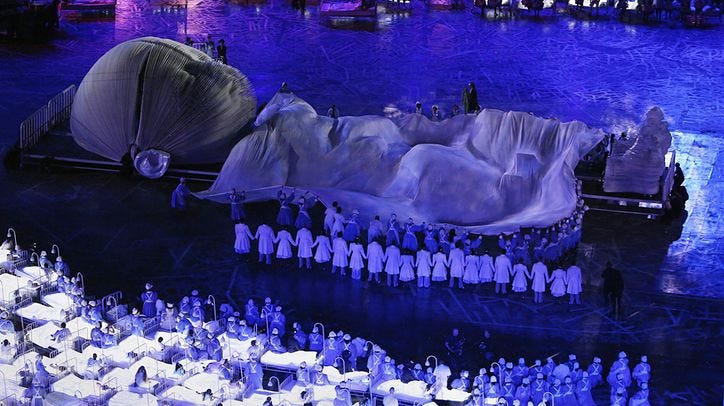
This isn’t an edge case; it’s the point of the form. London 2012 made that visible in a liberal-democratic register: Danny Boyle’s ceremony turned the National Health Service into national iconography—hospital beds, nurses, childhood, care—an artistic tribute many read as politically charged precisely because it elevated a public institution into the nation’s self-image. Olympic ceremonies routinely translate political values into culture so the message arrives as heritage, humor, or heart rather than argument.
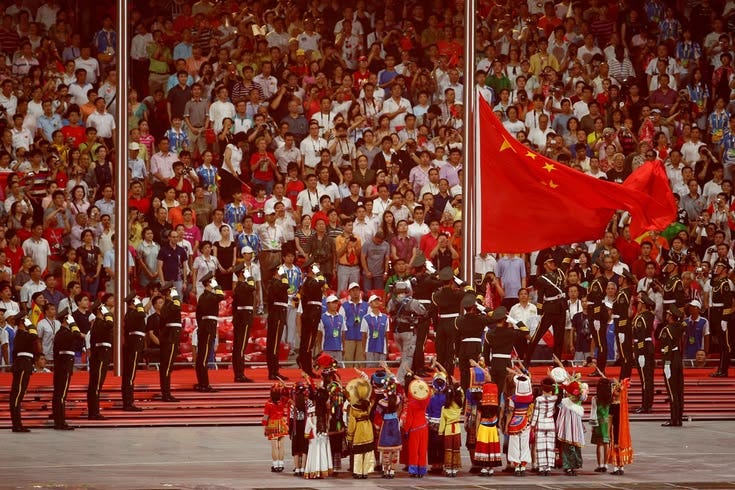
And if London 2012 shows how ceremony can turn a civic value into myth, Beijing 2008 and Sochi 2014 show what happens when mythmaking is harnessed to geopolitical messaging and domestic power. The Play the Game piece notes research showing that both Olympics had two broadcast versions of the opening ceremony—one for domestic state television and one for international viewers—with significant differences between them. In the Chinese broadcast, the camera returned again and again to then–head of state Hu Jintao—especially during the parade of nations when Hong Kong and “Chinese Taipei” entered—producing a message about sovereignty through camerawork alone. The same analysis describes how the ceremony performed “ethnic integration” via children presented as representatives of China’s 56 ethnic groups—an image later complicated by reports the children were actually Han Chinese—turning “harmony” into choreography.
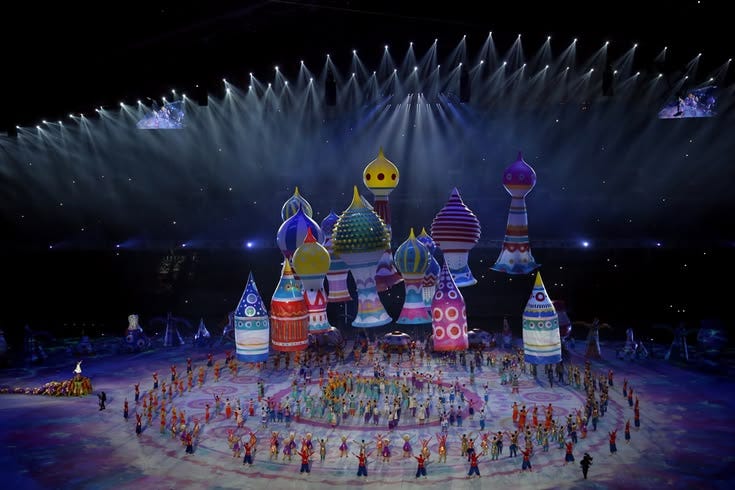
Sochi 2014 follows the same logic with different iconography. The ceremony gave Vladimir Putin a stage for visibility management—shown far more often in the domestic broadcast than the international one—alongside an intensified display of national symbols. And it did not avoid Western criticism of Russia’s homophobic laws so much as answer it aesthetically: a segment honoring the traditional nuclear family, plus imagery that staged the alignment of church and state—St. Basil’s Cathedral appearing under the letter meaning “we,” then returning later as a constructed cathedral form. In other words: politics presented as culture, ideology presented as atmosphere.
And when it isn’t the ceremony that becomes the battleground, it’s the athlete. U.S. skier Hunter Hess was asked to weigh in on the political climate in the United States; after he spoke candidly, President Donald Trump attacked him publicly, and other U.S. athletes defended Hess’s right to speak. Politics doesn’t enter the Olympics by accident—it’s produced by the machinery that surrounds the Games: interviews, headlines, partisan incentives, and the viral afterlife of a quote.
Taken together, these episodes clarify what the Olympics actually run on. The IOC operates as an image-governance regime. It doesn’t keep politics out; it adjudicates which politics are allowed to look like “culture” and which must be treated as “propaganda.” Nationalism is permitted because it is the Games’ native language—flags, anthems, medal counts, the spectacle of sovereign competition. Dissenting history is disciplined: anti-colonial revolution becomes too “political” to wear, queer visibility becomes a flashpoint to apologize for, and an athlete’s speech becomes a problem the moment it escapes the approved script. Neutrality, in this frame, is not an absence of politics. It is a method of control.
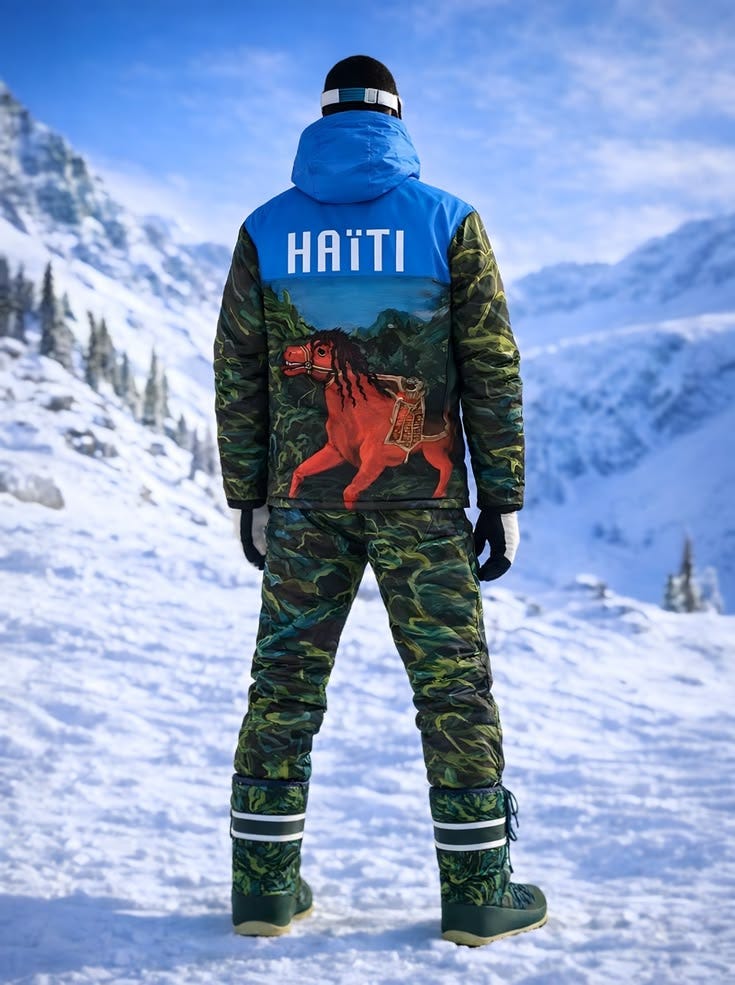
In the end, Haiti’s uniform tells the truth the IOC keeps trying to edit. The red horse still charges across the fabric, but the rider has been removed—revolution reduced to scenery, sovereignty made acceptable only once it’s less legible. Jean is right: the absence speaks, a negative space marking the boundary the IOC won’t name. If the Olympics are a global exhibition of nationhood, then an apolitical Olympics is an impossibility. Some histories are welcomed as heritage. Others—especially the ones that prove empires can be defeated—are treated as contamination. Politics isn’t missing from the Games. The question is whose politics get to be seen.
Reporting and referenced analysis:
Jo Lawson-Tancred, “Haiti’s Hand-Painted Winter Olympics Uniforms Are a ‘Story of Resistance’,” Artnet News (Feb. 6, 2026).
Reuters, report on Paris 2024 opening ceremony backlash and organizers’ apology/denial (July 27–28, 2024).
Play the Game, “The Political Power of the Olympic Opening Ceremony: Lessons from Beijing and Sochi” (Jan. 19, 2022).
Reuters, report on U.S. skier Hunter Hess, Trump’s response, and athletes defending his right to speak (Feb. 2026).
The silencing of what the IOC deems “appropriate standards” raises serious concerns. Perhaps the Olympic Committee needs an independent commission to address these complex issues - for the IOC decision makers. Between what’s happening in Haiti and the Ukrainian athlete honoring fallen Olympians, where do we draw the line between morals and politics? We need love, compassion, respect and the truth.
Thank you for such a thoughtful and informative article!