
Exorcising Restraint — Ramekon O’Arwisters’ Schism
Quilts that hold, clamps that hold you still: a meditation on liberation

Before we learn who we are, we learn how to be read. So much of public life is a quiet negotiation with legibility—how a face, a body, a voice will be judged before it’s heard. You trim what is essential to you—how you love, how you move, what grows naturally from you—to calm other people’s fears. You manage softness so it isn’t mistaken for weakness; you manage strength so it isn’t mistaken for threat. Over time, the management hardens into method. It becomes routine: the pose, the smile, the careful sentence that tucks the rest of you out of sight.
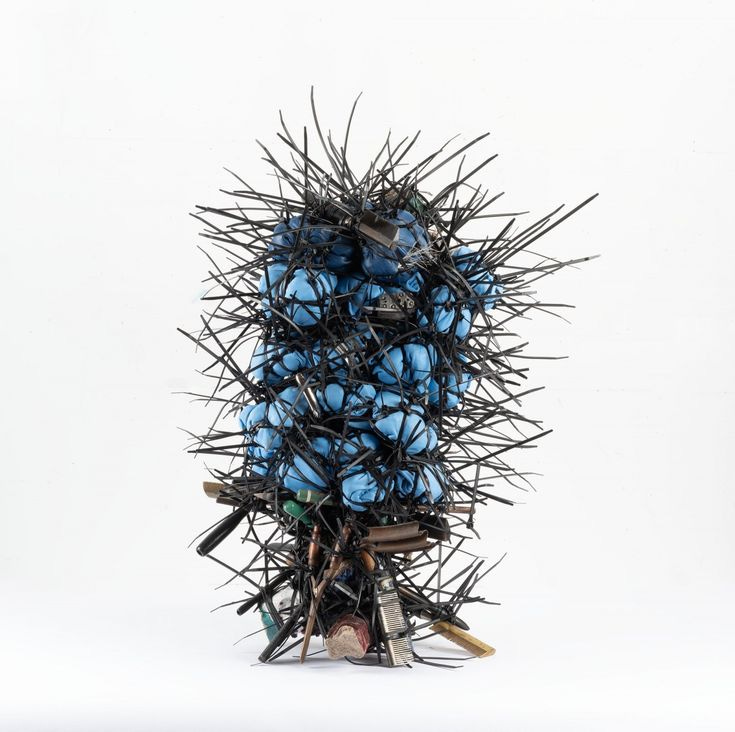
Ramekon O’Arwisters knows this choreography from the inside. He has spoken about choosing the most restrictive spaces when restriction already defined his life, and about the cost of being made acceptable. His rejoinder is simple and demanding: “My creativity has only asked me to be authentic, courageous, persistent.” Schism, his most recent exhibition at Patricia Sweetow’s Los Angeles gallery, is that rejoinder turned into matter. Bound sculptures bristle with repurposed implements and hardware—devices that render compliance visible—while quilt-like tapestries, stitched from bright fabric strips that honor his grandmother, hold a lineage of acceptance and care. Even there, history interrupts: drapery cords forming loops that recall nooses cut through the color. The point isn’t to choose between tenderness and coercion; it’s to see how they’ve been sutured together—and how the work begins to unpick the seam. Schism is not a purge; it’s an exorcism of what never belonged.
O’Arwisters maps restraint across the physical, mental, and emotional, then models unbinding by recoding tools, activating craft lineages, and refusing the mask of acceptability. The work teaches how tenderness and coercion can inhabit a single object—and how making itself can become a method of freedom.
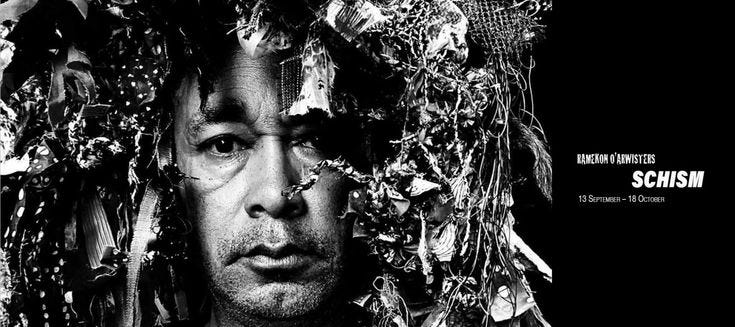
O’Arwisters’ materials read like a glossary of control. Hot combs and curling irons arrive first as instruments of care, but inside the sculptures they feel like accomplices—tools that promise belonging if you’ll submit to heat. The subtext is the politics of “taming”: wild, unruly Black hair is admitted only when corrected—straightened, subdued—to satisfy a dominant gaze (a pressure the artist has compared, conceptually, to the fear that wildness can trigger before it’s understood). In the artist talk, he named the “Stockholm syndrome” of grooming—learning to love the device that disciplines you. Heat becomes the pedagogy; assimilation, the lesson. This isn’t an indictment of style; it’s a reckoning with the demand to be “fixed”—the insistence that what grows naturally (the wild hair of Black women, especially) must be restrained to be acceptable.
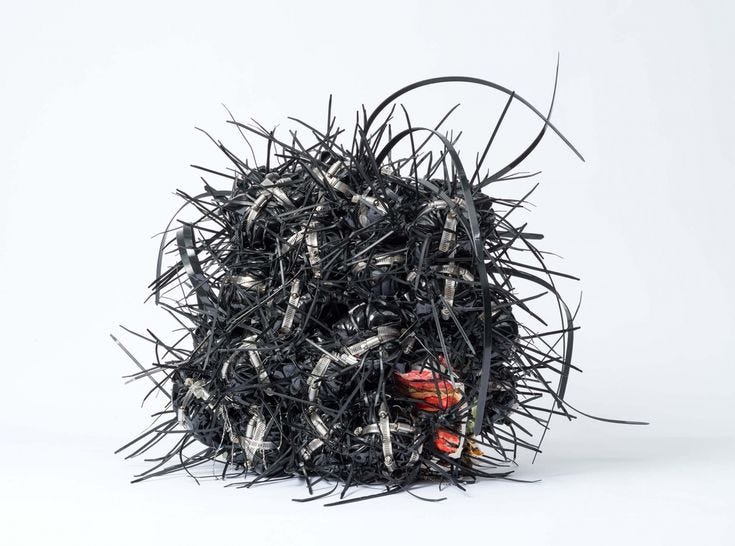
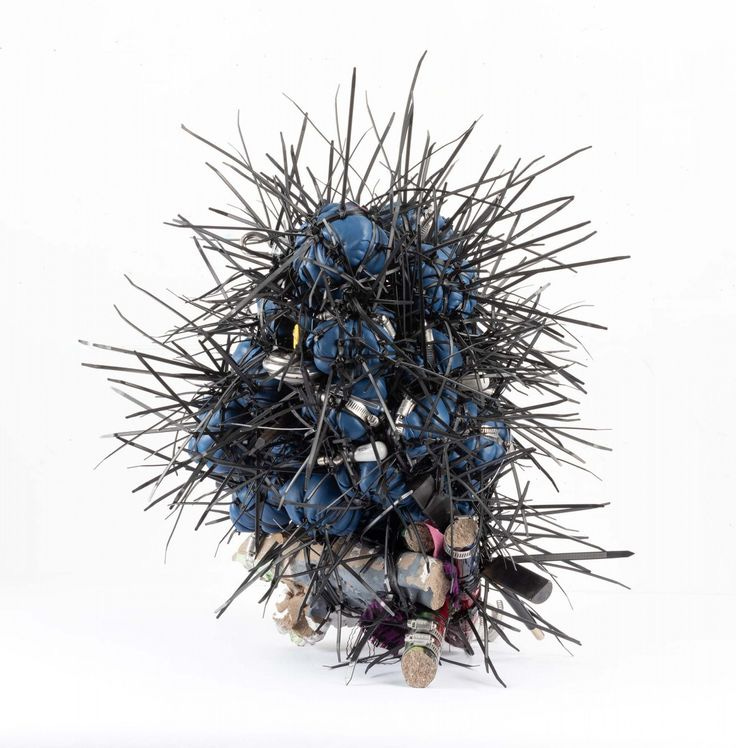
Zip ties and clamps escalate that logic from suggestion to command. They don’t persuade; they immobilize. Their cheap, industrial efficiency matters—mass tools for mass compliance. The way certain zip ties are cinched and splayed carries an arachnid charge—tight bodies with radiating “legs” that recall creatures covered in hair and commonly met with fear—turning containment into a social diagram of how the unfamiliar gets managed. In the compositions, they function like hinges and ligatures, holding disparate parts together the way social norms hold a persona in place. If the irons ask you to adjust, the clamps insist you conform.
Leather complicates the reading further. As both skin and fabric, it toggles between armor and harness—protective exterior and restraining strap. It’s tactile and seductive, yet its seams diagram control: how the body is shaped, cinched, presented. Worn or woven through the works, leather sits at the threshold between costume and self, raising the question: when is presentation a defense, and when is it a leash?
Together, these materials model how restraint moves across registers. Psychological restraint whispers through the beautifying tool; physical restraint snaps shut with hardware; social restraint threads through surfaces that script the body’s behavior. None of it is neutral. Each object carries a history of use that the sculpture refuses to launder. By keeping the mechanisms visible—teeth of a clamp, serration of a zip tie, the burn-memory of a hot comb—O’Arwisters denies the comfort of abstraction. You’re not looking at “themes”; you’re looking at instruments. Naming them is the first unbinding.
If the sculptures expose the machinery of restraint, the quilts remember another inheritance. Stitched from bright fabric strips, these works honor O’Arwisters’ grandmother—the hours of sewing, the way color can gather a room and say, without fuss, you belong here. For a gay Black boy in the South, that table was more than craft; it was cover. The quilt became a grammar of acceptance: pattern as permission, touch as proof.
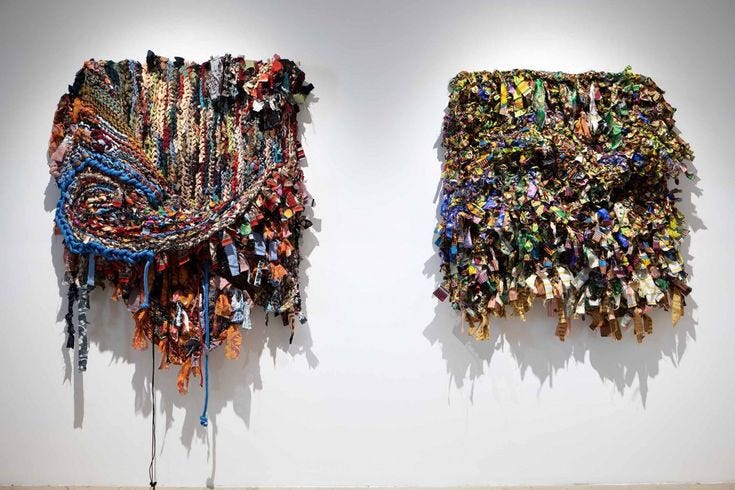
But sanctuary isn’t the same as safety. Even within this chromatic embrace, history interrupts. Drapery cords—knotted into loops that recall nooses—thread through the softness, naming the ambient threat that shadows Black life and queer life in the South. They read as both restraint and warning: what holds can also hang. The quilts refuse amnesia; they insist that care and danger have long shared a house, sometimes a single object.
What the quilts model, then, is a different kind of binding. Not the clamp that immobilizes, but the stitch that keeps—keeping memory, keeping lineage, keeping the self intact when the world demands correction. The hand is legible here: seams that carry touch, choices that privilege saturation over shrinkage. The works do not cancel the sculptures’ severity; they place it in counterpoint. Where the hardware diagrams capture, the quilts diagram continuance.
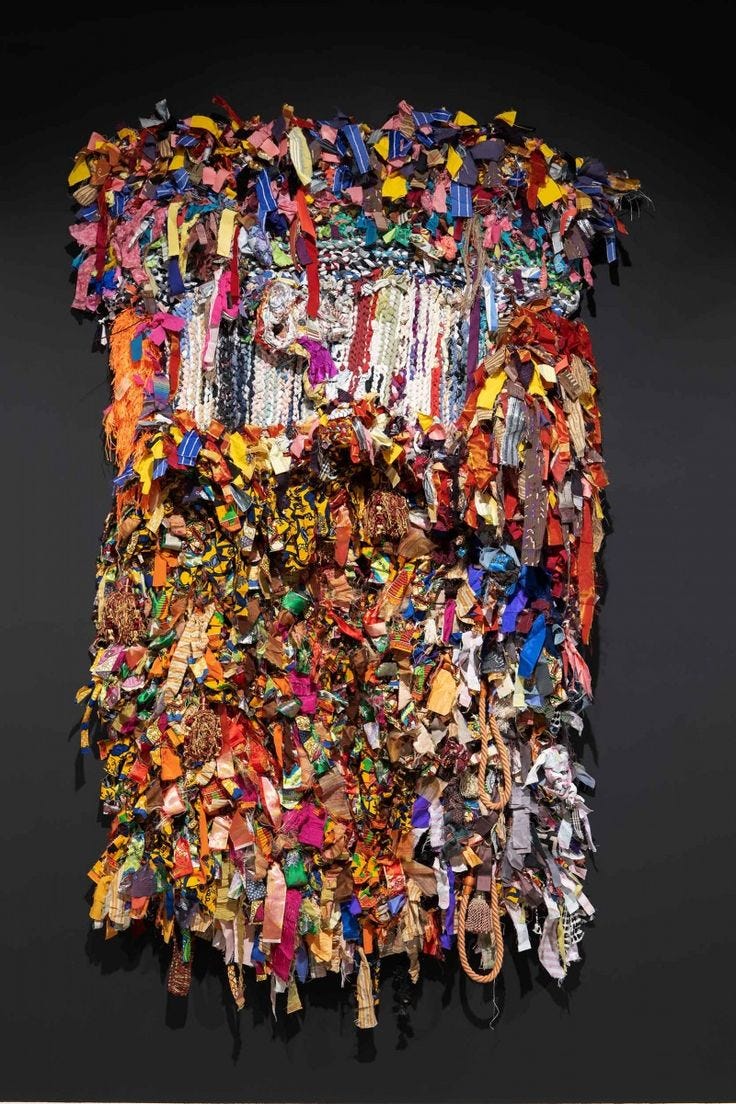
This is the hinge. Liberation isn’t only the removal of restraints; it’s the presence of structures that hold without diminishing. In the quilts, O’Arwisters proposes a practice of binding that preserves what is unruly and alive. The question becomes not whether to bind, but how—and to whom we tether.
O’Arwisters has described choosing to attend seminary—“the most restricted institution”—at a time when restriction already defined his life. Viewed alongside that history, it’s a telling paradox of control: when a culture narrows you, institutions that ritualize narrowing can appear to offer order, shelter, even purpose—entering a place of sanctioned restraint precisely when restraint had already configured his life. In that context, restraint isn’t just social; it’s sanctified. Obedience becomes liturgy. Desire is translated into sin and filed under discipline. You learn a choreography of denial not as a private quirk but as a moral requirement.
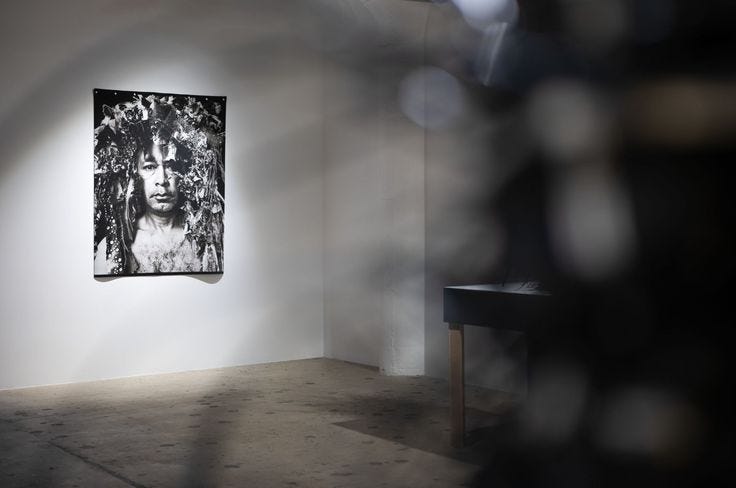
That biography isn’t a footnote; it’s the binding thread that stitches the exhibition together. The comfort of quilting with his grandmother sits in deliberate tension with the obvious binding of the sculptures. Heavy drapery fabrics are stitched to Dutch wax cloth—domestic weight meeting diasporic color—and, inside those seams, drapery cords tied into loops that recall nooses keep the threat in frame. The same logic repeats across materials: where one form offers cover, another clarifies the cost.
Hardware doesn’t merely hold things together; it codifies what counts as permissible. Clamps read like purity scripts—tight, repetitive, unquestioned. Zip ties operate with bureaucratic efficiency: once fastened, the mechanism assumes itself right. Nothing about these devices asks why; they only enforce how.
Against that, the work proposes a different relation to ritual. Where routine numbs, ritual should transform. The sculptures refuse euphemism—showing serrations, teeth, bite—so the viewer can see the mechanism and decide whether it belongs. The aim isn’t spectacle or confession; it’s alignment. Remove what was added for approval; keep what is essential to the life.
Liberation here isn’t the absence of ties; it’s choosing which ones deserve to hold. O’Arwisters distinguishes between bindings that standardize and bindings that sustain—between the clamp and the stitch. One enforces sameness; the other keeps what’s singular alive.
If restraint trained a lifetime of edits, Schism models a different maintenance: let fall what was fastened onto you; keep what grew from you. Trade correction for care, standardization for structure, surveillance for sanctuary. The color stays. The touch stays. The lineages that made you—grandmothers, craft, communities—stay.
Exorcism, in this register, is patient work. Not spectacle, but the steady unthreading of what never belonged so that breath can return to the body—and the body can return to itself.